


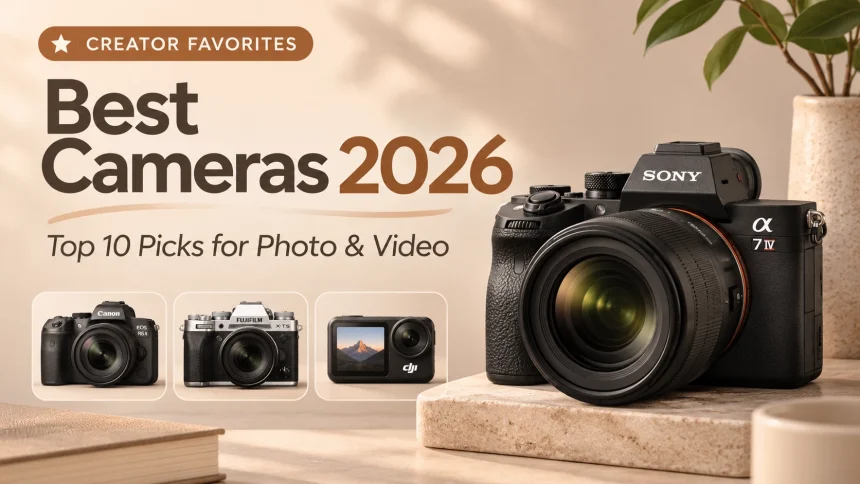
Best Cameras 2026: Top 10 Picks for Photography and Video
Best Cameras 2026: Top 10 Picks for Photo & Video.Choosing a new camera sounds exciting until you start comparing dozens of models. Some offer incredible photo quality but have limited video features. Others are made for filmmaking, while compact cameras focus on portability and ease of use.
The good news is that you don’t need the most expensive camera to capture beautiful photos or professional-looking videos. What matters is finding one that fits the way you shoot.
In this guide to the Best Cameras 2026 strong>, we’ve selected 10 mirrorless cameras worth considering for photography, filmmaking, YouTube, travel, and everyday content creation. From beginner-friendly options to professional full-frame models, there’s something for different budgets and experience levels.
We’ll look at their key features, practical advantages, limitations, and who should buy them.
Top 10 Best Cameras in 2026 at a Glance
Short on time? This comparison table highlights the main strengths of each camera. Video specifications refer to supported maximum modes, which may involve cropping, specific recording formats, or additional storage requirements.
| Camera | Best For | Sensor | Video |
|---|---|---|---|
| Sony Alpha 7 V | Overall Photo & Video | 33MP Full-Frame | 4K 120p (Crop) |
| Canon EOS R6 Mark III | Action & Hybrid Shooting | 32.5MP Full-Frame | 7K 60p RAW |
| Nikon Z6 III | Hybrid Creators | 24.5MP Full-Frame | 6K 60p RAW |
| Sony Alpha 7R VI | High-Resolution Photography | 66.8MP Full-Frame | 8K 30p |
| Panasonic Lumix S5IIX | Filmmaking | 24.2MP Full-Frame | 6K 30p |
| Fujifilm X-T5 | Travel & Still Photography | 40.2MP APS-C | 6.2K 30p |
| Sony A6700 | Compact Hybrid Shooting | 26MP APS-C | 4K 120p (Crop) |
| Fujifilm X-S20 | Everyday Content Creation | 26.1MP APS-C | 6.2K 30p |
| Sony ZV-E10 II | YouTube & Vlogging | 26MP APS-C | 4K 60p |
| Canon EOS R50 V | Beginner Video Creators | 24.2MP APS-C | 4K 60p (Crop) |
Note: This is a feature-based selection, not a laboratory-tested ranking. Camera prices and regional availability can change.
1. Sony Alpha 7 V – Best Overall Camera for Photography and Video
The Sony Alpha 7 V is an excellent starting point for anyone who needs one camera for almost everything. It combines a 33MP full-frame sensor with fast autofocus, reliable subject tracking, and impressive video capabilities.
Whether you’re photographing portraits, capturing an event, or shooting a YouTube video, this camera offers plenty of flexibility without making you choose between photo and video performance.
Key Features
- 33MP partially stacked full-frame CMOS sensor.
- AI-based subject recognition and autofocus tracking.
- Up to 30fps electronic continuous shooting.
- Oversampled 4K 60p full-frame video.
- 4K 120p video in APS-C crop mode.
- In-body image stabilization.
What Makes It Worth Considering?
The biggest advantage is versatility. Its autofocus can follow moving subjects, while the sensor provides enough resolution for detailed photos and useful cropping.
The main drawback is its premium price. Also, recording at 4K 120p requires a cropped field of view, which matters when using wide-angle lenses.
Best for: Enthusiasts, wedding photographers, event creators, and anyone wanting a capable all-around camera.
2. Canon EOS R6 Mark III – Best for Action and Hybrid Creators
If you regularly switch between photography and filmmaking, the Canon EOS R6 Mark III deserves serious attention.
With a 32.5MP full-frame sensor, advanced autofocus, and high-speed burst shooting, it is designed to handle subjects that don’t stay still. It’s particularly attractive for events, wildlife, and fast-moving action.
Key Features
- 32.5MP full-frame CMOS sensor.
- Up to 40fps electronic burst shooting.
- Advanced subject detection and tracking.
- Internal 7K video recording up to 60p in RAW Light.
- 7K Open Gate recording up to 30p.
- In-body image stabilization and dual card slots.
What Makes It Worth Considering?
The combination of fast photography and high-resolution video is its biggest selling point. Open Gate recording is particularly useful for creators who need to turn one recording into both landscape and vertical videos.
However, high-quality RAW recording produces large files and requires fast storage. Beginners may not need all these advanced features.
Best for: Wedding photography, sports, events, wildlife, and professional hybrid content creation.
3. Nikon Z6 III – Best Full-Frame Camera for Hybrid Creators
The Nikon Z6 III offers a thoughtful balance between still photography and advanced video recording.
Its 24.5MP partially stacked full-frame sensor supports fast processing, while Nikon’s autofocus system makes it useful for portraits, moving subjects, and everyday shooting.
Video creators also get internal RAW recording options that are usually associated with more specialized production equipment.
Key Features
- 24.5MP partially stacked full-frame sensor.
- EXPEED 7 image processor.
- Internal 6K 60p RAW video recording.
- 4K recording at high frame rates.
- Subject-detection autofocus.
- In-body image stabilization.
What Makes It Worth Considering?
The Z6 III is especially appealing if you want professional video features without moving to a much larger cinema-focused setup.
Its 24.5MP resolution is sufficient for many photography projects, although photographers who frequently produce very large prints may prefer a higher-resolution camera.
Best for: Portrait photographers, freelance videographers, and creators who shoot both photos and videos.
4. Sony Alpha 7R VI – Best for High-Resolution Photography
For photographers who care about fine details, the Sony Alpha 7R VI is one of the most interesting premium cameras to consider in 2026.
Its 66.8MP full-frame sensor provides impressive room for cropping and large prints. That makes it particularly useful for landscape, commercial, product, and detailed portrait photography.
Despite its photography-focused design, it also offers serious video capabilities.
Key Features
- 66.8MP fully stacked full-frame CMOS sensor.
- Advanced AI-powered autofocus.
- Up to 30fps continuous shooting.
- 8K video recording up to 30p.
- 4K video up to 120p.
- High-resolution electronic viewfinder.
What Makes It Worth Considering?
The extra resolution provides real flexibility for detailed commercial work and professional prints. It can also help wildlife photographers crop images while retaining useful detail.
On the other hand, large image files demand more memory-card space, processing power, and storage. The camera’s price also makes it difficult to justify for casual photography.
Best for: Landscape, commercial, product, studio, and high-resolution photography.
5. Panasonic Lumix S5IIX – Best Camera for Filmmaking
The Panasonic Lumix S5IIX is an appealing choice for filmmakers who want advanced recording options in a relatively compact full-frame camera.
While many hybrid cameras prioritize photography, the S5IIX gives video creators extra control over recording formats and production workflows.
Key Features
- 24.2MP full-frame CMOS sensor.
- Phase Hybrid autofocus system.
- 6K video recording up to 30p.
- 10-bit recording options.
- ProRes recording and external USB-SSD support.
- Active image stabilization.
What Makes It Worth Considering?
External SSD recording is a practical advantage for video projects that produce large files. The camera also supports professional recording workflows that offer more flexibility during editing.
For someone who mainly takes family photos or occasional travel videos, these features may be more than necessary.
Best for: Independent filmmakers, documentary creators, music videos, and professional video production.
6. Fujifilm X-T5 – Best for Travel and Still Photography
Not every photographer wants a large full-frame camera. The Fujifilm X-T5 combines a relatively compact APS-C system with a high-resolution 40.2MP sensor.
It also offers Fujifilm’s popular Film Simulation modes, which make it easier to explore different color styles without spending hours editing every image.
Key Features
- 40.2MP APS-C X-Trans CMOS sensor.
- Fujifilm Film Simulation modes.
- Classic photography-oriented control dials.
- In-body image stabilization.
- 6.2K video recording up to 30p.
- Compact, photography-focused design.
What Makes It Worth Considering?
The X-T5 is enjoyable for photographers who like having direct control over exposure settings. Its resolution also makes it suitable for detailed landscapes and travel photography.
Although its video features are capable, people who primarily shoot themselves on camera may prefer a model with a more video-oriented screen and controls.
Best for: Travel photographers, street photography, portraits, and enthusiasts who enjoy creative photography.
7. Sony A6700 – Best Compact Camera for Photo and Video
The Sony A6700 is a strong option for creators who want advanced performance without carrying a full-frame setup everywhere.
Its 26MP APS-C sensor delivers detailed photographs, while AI-based autofocus helps keep moving subjects in focus.
It’s a particularly useful choice for travel, everyday filmmaking, and content creation.
Key Features
- 26MP APS-C back-illuminated CMOS sensor.
- AI-powered subject recognition.
- 4K 60p video with 6K oversampling.
- 4K 120p recording with a crop.
- Five-axis in-body image stabilization.
- Compact body and Sony E-mount lens support.
What Makes It Worth Considering?
The A6700 offers an excellent mix of portability and advanced features. Its interchangeable lens system also gives you room to grow as your photography skills improve.
One limitation is its single memory-card slot, which some professional event photographers may find restrictive.
Best for: Travel, everyday photography, YouTube videos, and creators wanting a smaller hybrid camera.
8. Fujifilm X-S20 – Best Lightweight Hybrid Camera
The Fujifilm X-S20 is a versatile choice for creators who don’t want a complicated camera setup.
It brings together a 26.1MP APS-C sensor, in-body stabilization, a vari-angle screen, and impressive video options in a relatively small body.
That makes it well suited to people who move between travel photography, short videos, and everyday creative projects.
Key Features
- 26.1MP APS-C sensor.
- 6.2K 30p internal video recording.
- 4K recording up to 60p.
- In-body image stabilization.
- Dedicated Vlog mode.
- Fujifilm Film Simulation modes.
What Makes It Worth Considering?
The X-S20 offers a friendly balance of creative photography and modern video tools. Its Film Simulations also help beginners experiment with different visual styles.
However, photographers who regularly work in challenging outdoor conditions may want a more rugged, weather-resistant camera.
Best for: Travel vloggers, lifestyle creators, hobby photographers, and everyday content creation.
9. Sony ZV-E10 II – Best Camera for YouTube and Vlogging
If your main goal is creating YouTube videos, the Sony ZV-E10 II is an option worth exploring.
Unlike cameras built primarily around traditional photography, this model focuses on video-friendly controls and features that make filming yourself more convenient.
It also uses interchangeable lenses, allowing you to change your setup as your content improves.
Key Features
- 26MP APS-C CMOS sensor.
- 4K video recording up to 60p.
- 10-bit 4:2:2 video recording.
- Reliable subject-tracking autofocus.
- Vari-angle touchscreen.
- Built-in directional microphone system.
What Makes It Worth Considering?
The ZV-E10 II is especially useful for talking-head videos, product demonstrations, tutorials, and everyday vlogs.
However, it doesn’t have a built-in electronic viewfinder or mechanical in-body image stabilization. If you plan to walk while filming, choosing a suitable stabilized lens or additional support may improve your results.
Best for: YouTubers, vloggers, online educators, and social media creators.
10. Canon EOS R50 V – Best Camera for Beginner Video Creators
The Canon EOS R50 V is designed for people who want to move beyond smartphone video without immediately investing in a professional camera system.
It offers a 24.2MP APS-C sensor, modern autofocus, and useful recording controls in a compact body.
For new YouTubers, streamers, and content creators, it offers an approachable way to learn proper camera settings and interchangeable lenses.
Key Features
- 24.2MP APS-C CMOS sensor.
- Dual Pixel CMOS AF II.
- Oversampled 4K 30p video.
- 4K 60p recording with a crop.
- 10-bit video and Canon Log 3 support.
- Vertical video and livestreaming features.
What Makes It Worth Considering?
Its video-focused controls and autofocus make it a practical entry point into dedicated video production.
However, the R50 V has no built-in viewfinder or sensor-shift image stabilization. Photographers who prefer composing through a viewfinder may find the regular EOS R50 more suitable.
Best for: Beginner YouTubers, streamers, product reviewers, and people starting video content creation.
How to Choose the Best Camera in 2026
A long list of camera specifications can feel overwhelming, especially if you’re buying your first interchangeable-lens camera. Before spending your money, focus on a few practical considerations.
1. Decide What You’ll Shoot Most
If photography is your priority, look for image quality, comfortable controls, and a suitable lens selection. For video, consider autofocus, stabilization, recording limits, and microphone connectivity.
When you need both, a hybrid camera is often the most practical choice.
2. Understand Full-Frame vs APS-C
Full-frame cameras have larger sensors than APS-C models and can offer advantages in low-light performance and depth-of-field control when compared under suitable conditions.
However, APS-C cameras are often smaller and can make a complete camera-and-lens kit more affordable. A good APS-C camera is more than capable of producing professional-quality results.
3. Don’t Judge a Camera Only by Megapixels
More megapixels can help with large prints and cropping, but they don’t automatically mean better pictures.
Lens quality, lighting, sensor performance, autofocus, and photography technique all matter. For many creators, a camera in the 24MP to 33MP range provides plenty of detail.
4. Check Video Features Carefully
Two cameras may both advertise 4K 60fps recording while delivering very different experiences.
Check whether recording uses the full sensor width or introduces a crop. Also consider stabilization, available color formats, overheating behavior, and storage requirements.
For regular YouTube videos, reliable 4K recording and good autofocus are often more useful than 8K resolution.
5. Consider Lens Availability
A camera body is only part of your photography setup. Lenses can have a major impact on sharpness, background blur, low-light capability, and creative possibilities.
Before choosing a camera brand, check the prices and availability of the lenses you expect to use in the future.
6. Set a Budget for the Complete Kit
Remember to account for more than the camera body. Depending on your needs, you may also want a memory card, spare battery, lens, microphone, tripod, or camera bag.
Sometimes choosing a slightly less expensive camera leaves enough money for a better lens, which can make a bigger difference to your final results.
Which Camera Should You Buy in 2026?
There isn’t one perfect camera for everyone. The most sensible choice depends on your work, experience, and budget.
- For the best overall balance: Sony Alpha 7 V is a strong option for photography and video.
- For fast action and events: Canon EOS R6 Mark III offers excellent burst shooting and advanced video features.
- For professional hybrid work: Nikon Z6 III combines capable still photography with powerful recording options.
- For high-resolution photography: Sony Alpha 7R VI is attractive for detailed images and large prints.
- For filmmaking: Panasonic Lumix S5IIX offers flexible professional recording options.
- For photography-focused travel: Fujifilm X-T5 provides high resolution and enjoyable manual controls.
- For a compact all-rounder: Sony A6700 balances portability and performance.
- For lightweight everyday content: Fujifilm X-S20 offers flexible photo and video capabilities.
- For YouTube: Sony ZV-E10 II is designed with video creators in mind.
- For beginner video creation: Canon EOS R50 V offers an accessible starting point.
Frequently Asked Questions
What is the best camera for photography and video in 2026?
The Sony Alpha 7 V is one of the strongest all-around choices thanks to its 33MP full-frame sensor, subject-tracking autofocus, and advanced 4K recording. However, the Canon EOS R6 Mark III and Nikon Z6 III are also excellent alternatives depending on your priorities.
Which camera is best for beginners?
The Canon EOS R50 V is a beginner-friendly option for video creation. If you want to concentrate more on traditional photography, also consider cameras with an electronic viewfinder and comfortable photo-oriented controls.
Is a mirrorless camera better than a DSLR?
Modern mirrorless cameras often provide advanced autofocus, electronic viewfinders, and strong video features in relatively compact bodies. However, existing DSLR equipment can still produce excellent photographs, so upgrading isn’t always necessary.
Do I need a full-frame camera for professional photography?
No. Many APS-C cameras can produce professional-quality images. Your lens, lighting, composition, and skill are often more important than sensor size alone.
Is 4K enough for YouTube videos in 2026?
Yes. 4K is more than sufficient for most YouTube videos. Clear audio, good lighting, stable footage, and engaging content usually matter more than recording at extremely high resolutions.
Should I buy an older camera model in 2026?
Absolutely, if the camera still meets your needs and offers good value. An older model with a quality lens can be a smarter purchase than the newest camera paired with unsuitable accessories.
Final Thoughts
The best camera is not necessarily the newest or most expensive model. It’s the one that helps you capture the photos and videos you actually want to create.
If you need a powerful hybrid setup, the Sony Alpha 7 V, Canon EOS R6 Mark III, and Nikon Z6 III deserve a place on your shortlist. For more specialized work, the Sony Alpha 7R VI and Panasonic Lumix S5IIX offer different strengths.
Meanwhile, compact options such as the Sony A6700, Fujifilm X-S20, Sony ZV-E10 II, and Canon EOS R50 V show that you don’t need a huge camera setup to create impressive content.
Before buying, compare current local prices, check lens availability, and think about how you’ll use the camera over the next few years.
Which camera would you choose for your photography or video projects? Share your thoughts in the comments below.
Official Camera Specifications and References
For detailed technical specifications, compatibility information, and the latest manufacturer updates, visit the official pages below.
- Sony Alpha 7 V – Official Product Information
- Canon EOS R6 Mark III – Official Specifications
- Nikon Z6 III – Official Product Information
- Sony Alpha 7R VI – Official Specifications
- Panasonic Lumix S5IIX – Official Product Information
- Fujifilm X-T5 – Official Specifications
- Sony A6700 – Official Product Information
- Fujifilm X-S20 – Official Specifications
- Sony ZV-E10 II – Official Product Information
- Canon EOS R50 V – Official Product Information